THE BREADMAKERS
There is a world of standing fire, crusted and cracked and lit from beneath, with no people on it, nothing grown, nothing built, and no reason the survey ever had to chart it beyond the ordinary thoroughness of charting. It is reached by a public veil that opens well below the surface, into a system of dry galleries cut through old stone. The catalogue holds the world for one thing done in one part of it. Crossers who have been call it the bakehouse world, and the survey has kept that for want of anything better, the world having no name that anyone has kept.
The galleries run near enough to moving magma that the rock holds a steady and even heat, which surveyors have set down as the heat of an oven kept for work rather than the heat of a furnace. Ordinary protective gear is enough. A crosser may walk the worked galleries for hours in reasonable comfort, and many have.
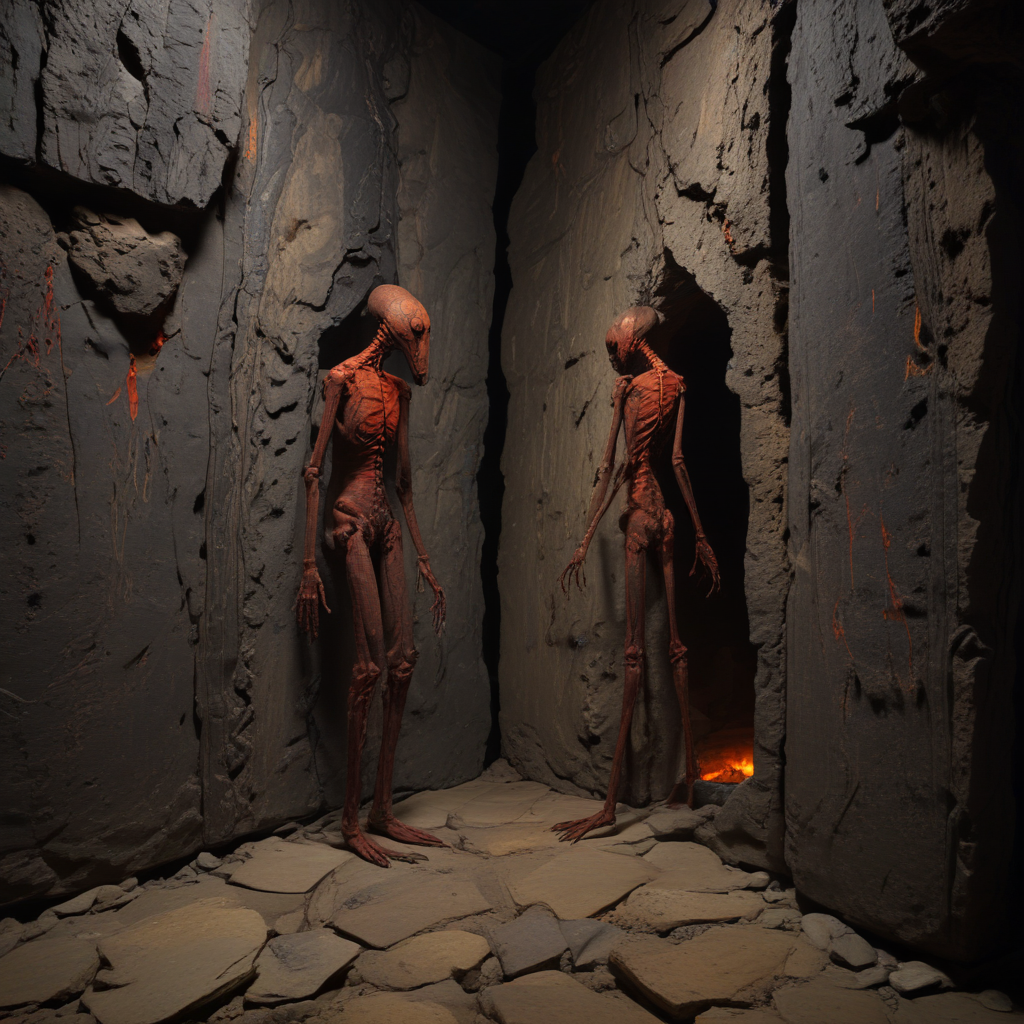
In the deepest of those galleries stands a second veil, which the Servatory did not chart, did not cut, and cannot use. It bears no helm. There is no station beside it, no plinth, no seat for a veilkey, and no working part a crosser could find, let alone turn. It is plainly made rather than found, fitted into the rock with care by hands that knew the stone. Who cut it, and from what side, is not established.
Through it, at intervals, come the people the catalogue calls the Breadmakers, that name being the Servatory's own, since they do not speak and have given nothing to be called by. They stand a little taller than a person and are long-limbed and slender to a degree that reads at first as frailty and is not. The nearest comparison in the survey's holdings, offered by an early crosser and never bettered, is something between an amphibian and one of the long stick-bodied insects of the old worlds: the skin dull and damp-looking and unbroken, the limbs thin and jointed high, the head narrow and turned mostly downward at the work. They wear nothing. They carry nothing but what they came to carry.
What they carry in is dough. It comes through the veil pale, slack, and unrisen, in shallow frames borne two to a bearer, and it is taken along the galleries and set into the heat, in places chosen with evident care and used again and again. The Breadmakers then wait. They do not turn the frames, or test them, or attend to them in any way the survey has been able to see. At a time they appear simply to know, they lift the frames out, and carry them back, and step through the veil, and are gone.
They work in shifts of twelve hours. The world turns slowly, its day and night together running near forty-eight, and so four shifts cover a full cycle, one crew passing out through the veil as the next passes in, with no greeting between them that a crosser would notice. The ovens are never cold and the galleries are never empty.
The survey has counted. Across a full cycle of that world, roughly one hundred and forty-four thousand loaves are brought through, baked, and taken back. The count has been taken more than once, in different years, and it varies little.
The bread is bread. This is the plainest fact in the account and the one the survey has least to say about. It goes into the heat pale and slack and it comes out risen and browned, evenly and well, in the manner of bread made by someone who has made a great deal of it. During the hours of the work the galleries smell of baking exactly as a bakehouse smells, and surveyors have set this down at length, at greater length than the anatomy or the veil, because it is the least explicable ordinary thing in the whole finding.
None of it is given. A crosser may not buy a loaf, trade for one, beg one, or take one. Asking, which can only be done by gesture, is neither answered nor refused; the loaf goes into the frame and the frame goes through the veil. Nothing has ever been left behind, and the survey means that plainly: no loaf, no fragment, no spilled flour, no swept crumb on the floor of a gallery worked for longer than the Servatory has known about it.
They are not hostile and have never been. A Breadmaker will not walk into a crosser; it will step around one, unhurried, and go on. It will not stop, or look twice, or object to being watched, or object to a crosser standing directly at the veil while it passes through. The survey holds this as accommodation without contact, and warns only that it should not be mistaken for welcome or for indifference, neither of which has been established.
The veil itself takes no one else. A crosser may stand in the arch of it and will find they are standing in an arch of worked stone. Nothing prevents the attempt, no one interferes with it, and nothing whatever comes of it. The Keeping's method for fitting a helm to a veil that carries none has been brought here and has not taken, and the survey does not yet understand why. Where the Breadmakers come from, what world wants a hundred and forty-four thousand loaves a cycle, and why bread should be worth cutting a veil into a burning world to bake, are matters the catalogue cannot presently reach.
The Servatory rates the Breadmakers at Open, which is not a concession and not a hedge. There is no harm here, no cost, no lure, and nothing owed. Go, if the odd draws you. Walk the galleries in the smell of baking, stand near the work, watch a people who will not look at you make bread very well for someone else, and come home with nothing but the account of it, which is all any crosser has ever come home with.
There the matter rests.